
A few weeks ago, an email came from an academic acquaintance, a former student of my father’s, forwarding a Google notification that the Jeopardy clues from November 18, 2025 included:
SNEAK PEEK CATEGORY: TREACHEROUS WORDS
($400) A treacherous person who strikes the fatal blow with a knife while you’re facing the other way
($800) The Ming-era “Book of Swindles” tells of “stealing silk with a decoy horse” in a chapter on this “look over here” 12-letter move
($1200) This hyphenated word for working deceitfully to harm others also means handing out 2 cards instead of one
($1600) Literary critic Wayne C. Booth coined this 2-word term for a first person storyteller who might not be trustworthy
($2000) Just like treacherous, this word that comes from “faithless” in Latin also ends in “o-u-s”(I got these from FikkleFame.com)
As I forwarded the Google snippet (not the SNEAK PEEK list) to my mother and sister, I attempted to explain Jeopardy to these non-TV watchers. I’ve barely followed it myself except when one of my graduate research assistants had a lucrative starring run before landing a tenure-track job. The immediate Booth trio (Mom and her two daughters) were tickled that the Kleenex-like term was linked to Dad’s name in a bit of popular culture. (OK, it’s not at the level of Scotch tape!)
For years, I’ve been aware of Threes Brewing, with five New York area sites, two in Brooklyn:
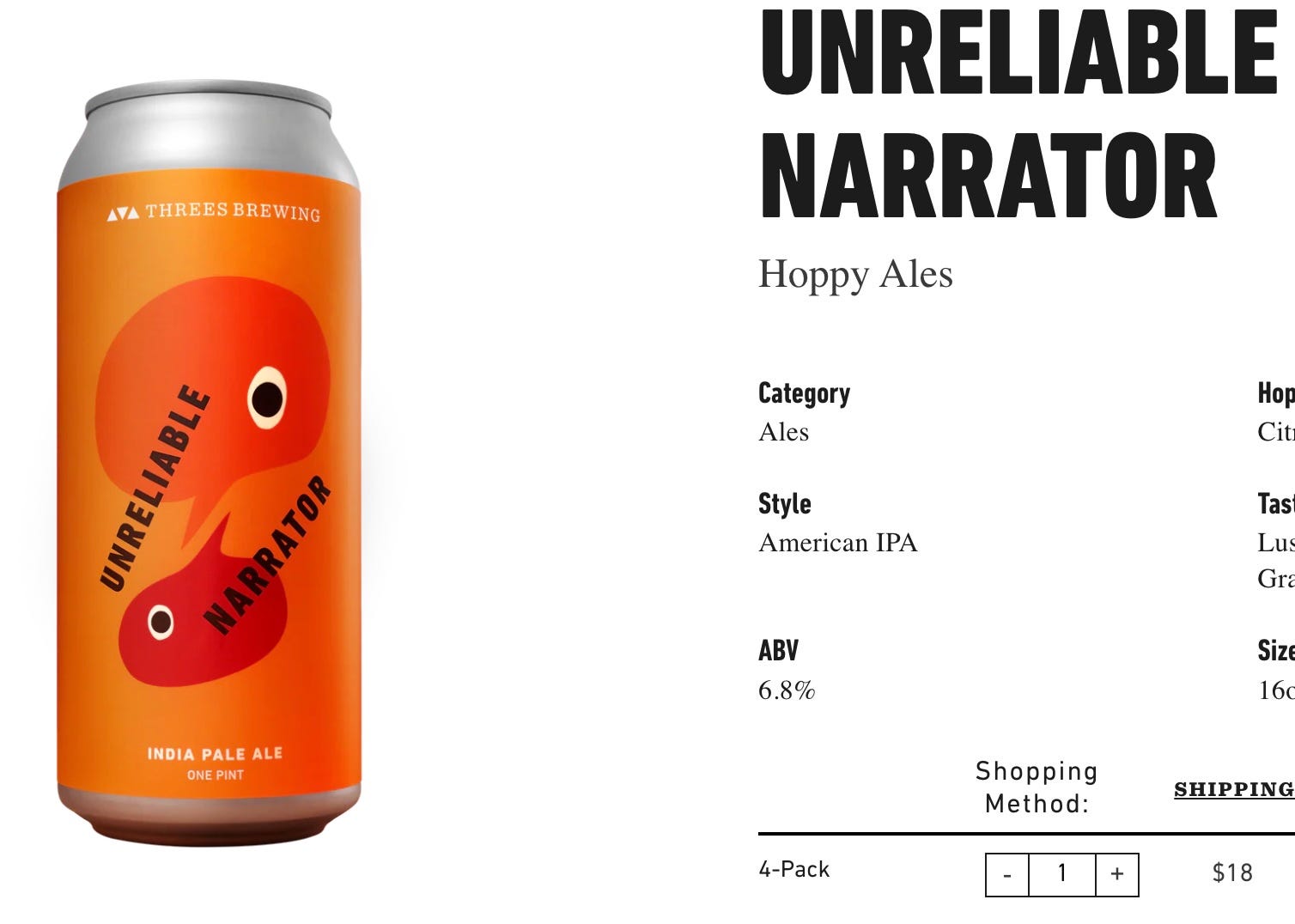
No copyright in ideas; not a trademark for the Booth family, certainly.
It’s not clear to me how the beer is telling a double-voiced or ironic tale, though I see the two speech bubbles on the can, profile to profile.
“Unreliable” misleads students to think it’s as simple as “fake news”: a pack of lies. Instead, any version is bound to be partial. Wuthering Heights. Rashomon. Other texts have multiple inner story tellers. It’s most vivid when a narrative has a single first-person narrator, who surreptitiously has perfect recall for dialogue and knows how to describe setting or fill in background; still, the reader experiences being the addressee of a human individual and wondering about other sides, or more, of the story.
Tale spinning.
Jeopardy: What is the spinning narrator?
But it takes more than two words, I know, to explain that it’s the reader who has to beware. Delicate clues don’t have yes/no or official-category answers. What is unreliable about Charlotte Brontë’s narrator, Lucy Snowe, in her last novel, Villette? No one supposes Lucy to be a cynical liar, nor is she obliviously trusting (she’s a bit of a surveillance camera). It takes unnaturally long for her to tell us that she recognizes a main character in (fictional) Belgium as having been a boy in her childhood foster home, and she swerves from her narrative duties on many occasions, covering private catastrophes in nautical metaphors and leaving alternative endings.
A Chinese narratologist, Dan Shen, my friend at conferences including at one she led in Shanghai, offers a very reliable article, “Unreliability,” in the Living Handbook of Narratology, 2011, revised 2013. Shen rightly starts with Booth’s innovation and moves to his student Jim Phelan’s extensive taxonomy of the varieties of unreliable narration in the rhetorical school of narrative theory.
Phelan identifies six types of unreliability which fall into two larger categories: (1) misreporting, misinterpreting (misreading) and misevaluating (misregarding); (2) underreporting, underinterpreting (underreading), and underevaluating (underregarding). The contrast between the “mis-” category and the “under-” category is basically a contrast between being wrong and being insufficient (2005: 34–37; 49–53). (Shen, par. 4)
It was partly the drive toward numbered taxonomies that made me keep some distance from narrative theory, though I use and teach it. Jim’s terms make sense to me when he elaborates his examples, which I won’t do here. Shen’s article elegantly consolidates important developments of the concepts by a range of critics in more recent decades.
Let this narrator admit that I have been in the thick of numbers and taxonomies (1s and 0s; ontologies) for more than two decades, in digital humanities. DH has a collaborative, practical build-something, public humanities mission statement that narratological concepts don’t offer, to me. It’s not lost on me that my father, an avid email user, never went into DH.
I am especially interested in nonfiction narration, in which the narrator and author are for most purposes almost indistinguishable, whether using the first person or not.
Any memoirist is telling a shaped story, and will be enticed into distortions or misreadings as well as omissions—a different account of experience than someone else might have observed. Sometimes the narrative has bothersome gaps (from the reader’s perspective) because it is protective or caring. Journalists agree to change the names of their subjects to protect them; eighteenth-century novels acquired the aura of nonfiction tell-alls by referring to characters as Mr. B__ and Lord Y__. But this erratic narrator does not wish to digress into all the ways a discourse can vary from the ostensible story of true events, revealing the character of the narrator.
We-moir or ‘life writing for us’?
A couple of days ago we were at a holiday party on our street—happy that a relatively newcomer couple reestablished the custom of annual gatherings for this slice of the neighborhood. About ten years ago, the longstanding holiday host was accused of a crime by another neighbor, and the conviction led to banishment from the street. So the holiday potlucks had stopped. I don’t know anything except hearsay, nor the whole story; I would be wrong in several senses to report it. I’m underreporting, but not to be deceptive.
A new December leaf was turned, and the neighborhood gathered, representing many new families and remodeled houses since we ourselves moved in in 1987. Dog-owning walkers, phone-gazing stroller-pushers, professors, retired doctors, a fair proportion of University of Virginia alums, gay world travelers, and the two most recent presidents of our synagogue, women who live across the street from each other.
I am chatting with a neighbor, K.C., who lives two houses down, an economics professor. Every two years or so we have a wonderful conversation with him and his wife and young daughter, now looking two years older. We are wearing nametags with the option of writing our favorite country on the label. K.’s American-born wife, J., wrote “Turkey”—the professor was born there. I wrote “England.”
“My father was an English professor and we lived there three times.” (When I was three and six, for half years; a whole year when I was fifteen. I’m silently recalling my junior year in college there.)
This reminds K. of something; he cheerily tells me he serves on a committee with a member of the Spanish department (one I know well, I’ll call him Professor P___), who was telling K. all about Wayne C. Booth’s “unreliable narrator,” and the daughter in the English department. Professor P__ said, “‘Every high school student in the US learns the concept,” K. reported.
K. was glad to make that family/neighbor connection to an idea not familiar to him, and I was glad to hear this tale, hearing the sound of Professor P__’s voice in my mind.
“I doubt that all high school students in America learn about the unreliable narrator,” I said.
My generation of academics is aging out; their graduate students and undergraduates don’t need to read The Rhetoric of Fiction to find a sophisticated critical position, and this trickles down to what is offered in high schools. The “fiction” that Wayne Booth thought of (English-language with French and a bit of German or Russian) in 1961 (new edition, 1983) has stretched to world literature and far more by women and people of color. Schools of thought become common knowledge or fade away.
But maybe it’s still common to be made to read (or get AI to do it if you prefer not to) Melville’s Bartleby the Scrivener. Or more likely, Edgar Allan Poe’s tales, among my favorites, “William Wilson,” which begins: “Let me call myself, for the present, William Wilson. The fair page now lying before me need not be sullied with my real appellation.” Or “Ligeia,” the narrator’s voice a Gothic sound effect, the deviousness wavering in the draperies of an antique bridal sickroom. The relentless voice can’t recall where he first met his eponymous wife, what her surname or ancestry was, how much opium he’s ingested and how the hell he has a new bride. Horrid crimes or proper misreadings can be exposed at an angle of evasion. It is an accessible idea.
Several kinds of unreliability are not at the very top of any list or taxonomy: being discrete not to protect yourself but to leave others be; muddling your own sense of time or events and letting people down—not while narrating. Not due to opium.
My Unreliability; Verifying Authorship and Truth or Fiction for Black Women Writers
As I suggested “spinning narrator,” I might push back on the censure in the concept “unreliability,” which in practice is almost inevitable. Undependable as a source of truth. Someone you would learn not to count on. The narrative concept obviously has stuck in many people’s minds as a useful one, as it indicates that you mostly have to deal with the implications of what is told, regardless of the teller’s intentions or designs. Some tellers are up to something besides trying to be trustworthy. But forgive them, sometimes they aren’t interested in avoiding plot holes or ineffective compressions.
We have become accustomed to very reliable clocks. Most of us have too many ways to be reminded, to keep a calendar. One sure-fire way for me to feel unreliable, to feel the burden of the world, is to sleep in. (I tend to fall back to sleep in the final hour, and so feel as bad as I do after a daytime nap.) I often do this when I have had a couple of sleepless hours in the night.
Two nights ago, as I often do, I got out of our bed and went across the hall to the other bedroom, turned on the light, and read for a while instead of bouncing around among my favorite topics, playing Connections, or even at times dictating notes for a next Substack post. I continued reading the paperback new edition of Hannah Crafts, The Bondwoman’s Narrative (2003; 2025). I’d known about the discovery since its 2003 publication but read it only this week.
Fairly disgusted with myself when I saw that I had slept in till almost 10 am, a teenage sort of time for a weekday! This comes of being on sabbatical, no moral pressure! I saw on my phone that I had texts. There, at 7:30 am, my friend who has cut my hair for 40 years, had sent a message: “I’ll see you at 7:45 AM.”
My text (still in my phone): Oh my, I’m so sorry 😞. I had not put it in my calendar. I just slept in really late. Forgive me
[It is true that I hadn’t put it in my calendar. Sometimes I get tricked because I do put it in one calendar on my phone which doesn’t show up in my laptop Outlook, but I had just overlooked this one, which was noted on a calendar card she had given me.]
When David walked in the door some twenty minutes later, he had shorter hair and a reproachful look. He sees the same hairdresser and had given her our Christmas card and gift check. Yes, she had mentioned that I missed my appointment. I’m still feeling bad.
Then a text at 12:34pm from her, which I’ll paraphrase as I haven’t asked her permission to quote (other than the innocuous first text reminding me). The gist is, she is sorry for me (“honey”); says when I didn’t show up she concluded it was a mistake because my last haircut was recent. In short, by the end of the exchange, she has sent 😘 and a teddy bear animation blowing red hearts and warm holiday wishes.
This is honestly a kind person, and she sure prevaricates nicely. I have gotten over my feeling about messing up the appointment. But I checked that all the next appointments really are in my calendar.
That night, I returned to my treat, the great new edition of The Bondwoman’s Narrative with notes on the varied allusions or replicated passages from other novels; a bibliography, appendix, clear indications of the handwritten revisions on most pages and detective-like report on the status of the manuscript. I enjoyed the many scenes of Hannah, the narrator’s, diplomatic interactions with her fretful mistresses or kind benefactors. Scenes, extended descriptions of houses, gardens, passages deploring the slave traders and the office seekers in the nation’s capitol, all declare it to be a novel while the narrator purports to be a real freedwoman, formerly enslaved, relaying what happened to her. She now has been identified, so the narrator is reliable about an outline of her life, it’s just not all her own remembered life; most of it is a novel. It is announced as the “first novel written by an enslaved Arican American woman.” Gregg Hecimovich and Henry Louis Gates Jr., with other assistance, have verified the unpredictable manuscript by a literate enslaved Black woman who sampled Bleak House and Jane Eyre among other texts in her master’s library or the girls’ school where she served.
This was a monumental scholarly discovery, resembling Jean Fagan Yellin’s confirmation that Incidents in the Life of a Slave Girl was based in true events and written by Harriet Jacobs, but the verification is of a different genre. The life of Linda Brent was thought to be fictional, though told as a literary memoir with real names changed—it is autobiography in its substance.
The unreliability of genre claims! Doubts of authorship have plagued African American literature since Phillis Wheatley. Crafts’ manuscript was evidently finished by 1858. I don’t recall any mention of clocks or timepieces in the novel, though hours or portions of the day and night are narrated. Poignantly, Hannah, the character-narrator, is a thoroughly reliable person, though accused of spreading family secrets.
One way to make time pass in a narrative: stop telling. Run ahead. Do as Crafts does more than once in The Bondwoman’s Narrative, sidestepping the novelist’s job because the reader doesn’t need to know. Much time is elided between chapters; it’s not just that I was reading in spurts in wee hours, the text is assembled from varied blocks of narrative. The ending of the novel is rushed. On her fortunate reunion with her beloved mother when both have attained freedom, in the final chapter, “In Freedom”: “So strong was her [the mother’s] faith that whenever she beheld a stranger she half-expected to behold her child. We met accidentally, where or how it matters not” (245).
Nothing more is said about what caused this invented happiest of endings.